
Return to Home Page
News and Views
This is the place where I share news with you about Richardson's history. It's also the place where I get to share my opinions, suggestions, and so on with the community at large.
Book Donation
(posted Thursday, September 10, 2026)
 On August 26, 2026, I met up with Librarian (and Historian) Stacey Davis at the Richardson Public Library, to donate a copy of my latest book, The Story of Miss Belle's Place: Along with Some Glimpses Into the History of Richardson, Texas.
Today, I checked the library's catalog to see if this book had been made available for borrowing and I am happy to report that it has. In fact, someone has it checked out right now! I am unable to tell you whether or not anyone else has put it "on hold."
However, if you don't want to wait until the books is returned, you can always buy your very own copy for $12.99, plus tax and shipping, from Amazon.com, where all 31 of the books I've authored or edited are currently available for sale, including A Sesquicentennial History of Richardson, Texas, Volume One and Volume Two.To learn more about the book, read my post from August 16th below.
My Proposals
(posted Thursday, August 20, 2026)
This is a follow-up to my previous posts of this past week.
At the next meeting of the Richardson City Council, I plan to suggest that the council mark the site of the first Houston & Texas Central railway depot, now that we know exactly where it was located, and also the grave of H.&T.C. Roadmaster Patrick J. Burke.
Below are four AI-generated pictures of the plaques I will be proposing that the city council erect.


The Lonely Roadmaster's Grave Found!
(posted Tuesday, August 18, 2026)
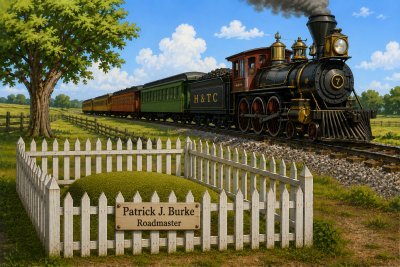 Two of the Richardson Railroad Reservation maps I obtained recently (see post dated August 14, 2026 below) pinpoint the location of something I didn't expect to see--namely the grave of Houston & Texas Central Roadmaster Patrick J. Burke, whose final resting place was described in an article about Richardson, printed in The Dallas Morning News on January 17, 1896:
"This is the first Dallas county town the southbound Houston and Texas Central train reaches. It is about 3 miles south of the Collin County line. Just as the train slows up at the depot, the passenger may see a little picket enclosure of about 4x7 feet in size alongside of the railroad track, and he wonders who the lone sleeper was that rests there in his narrow bed dug out of the black waxy soil of Dallas County. If he asks the conductor about it, he will be told that the 'lone grave at Richardson' is that of an early roadmaster of this line named Burke, who died of small-pox and was interred in this solitary grave upon the right-of-way of the road. The section boss of this part of the road is required by the company to take care of Burke's grave and keep up the pickets. In his lonely tenement, this once faithful employe of the road is still near the work he loved in life and his ashes are gently shaken by the passing trains."
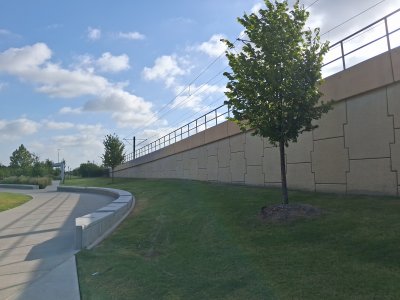 Comparing modern maps to the old maps, which include precise measurements of just about everything, including the depot and the width of the Railroad Reservation, has enabled me to find the gravesite of Roadmaster Burke with a reasonable degree of certainty. The picket fence is long gone, of course, and now the grave is unmarked, but if my calculations are correct, it is located either at or near a small tree that was recently planted in the new Interurban Common park that stretches north from W. Main Street to Greer Street, on the west side of the DART tracks that now run along what used to be the H&TC right-of-way.
So, who was Patrick J. Burke? Well, first of all, as the The News article says, he was a roadmaster for the Houston & Texas Central Railway, the company that founded Richardson in 1873 by building a depot in what is now Historic Downtown Richardson. This fact is confirmed by several more newspaper reports of the 1880s and '90s which identify "P. J. Burke" as an H.&T.C. Roadmaster and record his comings and goings primarily in Dallas, Fort Worth, and Denison.
Unfortunately, my efforts to find out more about the "Lonely Roadmaster" has not been as fruitful as I had first hoped. For instance, I have been unable to find out when or where he was born, nor do we know precisely when he died, although it was almost certainly sometime before September 17th, 1894, which is the date of the earliest known H.&T.C. Railway map showing the location of his grave, which was drawn on that date. Thanks also to the 1893 Dallas City Directory, we can be reasonably sure that he was still alive when that publication went to print because his name and address are listed in it--but he is not listed in any further Dallas directories.
I think however, that we can safely make some assumptions about Mr. Burke. First of all, in light of his name, he was almost certainly born in Ireland or had parents who were Irish immigrants, possibly as a result of the infamous "Potato Famine" of the late 1840s, and his middle name was almost certainly "Joseph" as both Patrick and Joseph were popular Irish first or middle names. The fact that he was buried on railroad property in Richardson almost certainly means he died there.
There are some certainties too. For example, I found that in 1881 he bought some property from his employer in a housing development the H&TC established on the edge of downtown Dallas and that he later had to sue the railroad to get his title to a certain misnumbered lot straightened out. I also know that he left the employ of the Houston & Texas Central for a while: First, in 1887, to serve as street overseer of the City of Dallas, and then, in 1888-1889, to work for another railroad, the Houston East & West Texas Railway (H.E. & W.T.), also as a roadmaster. During that time he lived in Houston, but by 1890, he was back in Dallas and working at the H.&T.C. again.
For day or two, I thought I had found some clues as to his origins and family connections. In a news report, I found there was a Pat Burk (no "e"), who also worked for the H.&T.C., who had an uncle, likewise an H.&T.C. employee, who died in Dallas in 1887, apparently of alcohol poisoning (i.e., he drank way too much whiskey). Newspapers reported his name as John Gavion. Using that clue, I found a Patrick Burk, age 24, born in Ireland, living in Fort Bend County, Texas in 1870, in the same household as a John Gavin (no "o"), also born in Ireland, the same age as the man in the 1887 report. Naturally, I thought I'd found him! The census also revealed that in 1870, the Fort Bend County Patrick Burke had a 16-year-old wife named Catherine. This was quite a discovery, because nothing in my earlier research had indicated that Patrick J. Burke was married. The fact that the Pat or Patrick Burk in these sources did not spell his name with a "e" at the end did not bother me because the "Lonely Roadmaster's" last name was spelled Burk instead of Burke in some Dallas directories, clearly a spelling error on the part of the directory publisher.
But then, I found a suit for divorce, in Collin County, Texas, in 1908, brought by a certain Catherine Burk against her husband, Patrick Burk, which clearly stated that they had been married in Fort Bend County in January 1870! Well, it was obvious. This Patrick Burk could not possibly be the same guy as the one buried beside the railroad track in Richardson in 1894! The fact that both men worked for the H.&T.C. was entirely coincidental.
Unfortunately, as I also discovered. there were quite a lot of men, many of them Irish immigrants, named Patrick J. Burke, in the time period in which our "Lonely Roadmaster" was alive and active. When I found a John Gavion in an 1877 St. Louis, Missouri city directory, for example, and then looked to see of a Patrick Burk or Burke also lived in the city at that time, I found no fewer than eight of them!
Thanks to the February 28, 1936 issue of The News, we also know that in the mid-1880s a Patrick Burk or Burke was a lieutenant in the "Hibernia Rifles," which according to Google Gemini, were "a local Irish-American militia company based in Dallas, Texas.During the 1880s and 1890s, they served as an official part of the Texas Volunteer Guard (the precursor to the modern Texas National Guard)." Gemini goes on to say: "The unit was primarily composed of working-class Irish immigrants and citizens living in Dallas. The name Hibernia is the classical Latin name for Ireland.During the late 19th century, it was highly common for distinct immigrant groups (such as Irish, Germans, and French) or local social clubs to form their own independent military companies. These groups would choose their own officers, select uniform styles, and practice drill movements." However, as it stands right now, I still don't know if the Pat Burk or Burke who served in the "Hibernian Rifles" was the one who was married to Catherine, or our "Lonely Roadmaster." Could be either one!
Another problem is that there seems to be no news report in any Texas newspaper of the period of the death of a roadmaster named Burk or Burke in Richardson, Texas in or around 1894. You'd think it would be mentioned, at the very least in passing, but it isn't.
Interestingly, in 1908, there was a Denison newspaper report of "our" Patrick J. Burke dying in the Confederate home in Austin, but the paper confused yet another P. J. Burke with the "Lonely Roadmaster" buried at Richardson.
Naturally, in the course of my research, I began to wonder: Just what is a "Roadmaster?" What does (or did) he do?
As it happens, "Roadmaster" was a fairly responsible high-ranking job in 19th Century railroading. According to the job description I found online, "A 19th century railroad roadmaster was responsible for supervising the maintenance and safety of a specific section of railroad track, ensuring it was in good condition for train operations. They managed track crews, coordinated repairs, and ensured compliance with safety standards."
This description certainly fits some of the generally sparse news stories I found about Mr. Burke. One report, which was printed in several Texas papers, including the February 4, 1886 edition of The Dallas Morning News, said:
"Foreman Pat Burke, on the Houston & Texas Central Railroad, met with what came near being a serious accident on yesterday. He was on his handcar with several men, when one of them lost his hold and fell back, knocking Mr. Burke off; both falling in front of the moving car, which was going slowly at the time and was stopped by them without any serious damage."
An earlier report, from 1882, says that Burke, then "supervisor of the north division of the Houston and Texas Central railroad," sustained serious but not life-threatening injuries when he fell from a car near the town of Alma, in Ellis County.
I've also found Burke listed in several Dallas city directories of the 1880s and '90s, his job title, "Roadmaster," included. There's no evidence of a Mrs. Burke, however, leading me to conclude that Burke never married.
As it stands now, we know for sure where Mr. Burke was buried and that the site is no longer marked, but I think it should be. After all, this is someone's grave. Therefore, I think that either DART or the City of Richardson, which leases Interurban Common from DART, should undertake to mark the gravesite of Patrick J. Burke in some appropriate way, and also, when that is done, to hold an appropriate ceremony of some kind on the spot, a suggestion I will almost certainly be making at a future meeting of the Richardson City Council.
HERE'S A FOLLOW-UP TO MY PREVIOUS POST: Last night, Monday, August 17, 2026, as planned, I did in fact give complimentary copies of my latest book, The Story of Miss Belle's Place, to Amir Omar, the Mayor of Richardson, Don Magner, the City Manager, all the currently serving city council members, and Crystal Brown, City Secretary, as a "Thank You" for moving the Hill-Robberson House to Huffhines Park and for taking steps to restore it to its former glory, so to speak. At the meeting, I also got 5 minutes to tell them a little bit about the book and why I wrote it. The next thing I plan to do is donate one or more copies to the Richardson Public Library and also send a complimentary copy to the head of the Richardson Independent School District, Tabitha Branum, as well as all the 7th grade Texas History teachers in R.I.S.D. because one of the primary reasons I wrote the book was to make up for the fact that few, if any, students in the schools of R.I.S.D. are learning anything about the history that's right on their doorstep, so to speak, and I want to do something positive about that deficiency.
Some More Exciting News!
(posted Sunday, August 16, 2026)
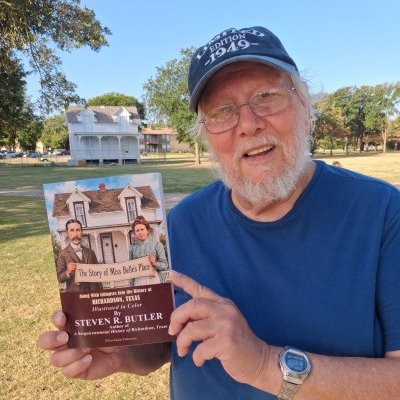 Yesterday, I received my first order of author copies of my new book, The Story of Miss Belle's Place, which was published on August 4, 2026 by Poor Scholar Publications. Its subtitle is "Along with Some Glimpses Into the History of Richardson, Texas."
My plan is to present the Mayor of Richardson, along with members of the City Council and the City Manager, with complimentary copies of the book at the City Council Meeting scheduled for Monday, August 17, 2026.
For those of you who may not know, "Miss Belle's Place," or more properly, the Hill-Robberson House, is one of the oldest surviving residences in Richardson. It was built about 1887 at the behest of the principal of what was called the "Wheeler School" (because it was adjacent to a farm owned by a man named Wheeler). His name was Professor Albert Henry Hill. Owing to illness, he resigned his post in 1889, and returned, with his wife, to his native Kentucky. Before leaving, he sold the house to a man named "Uncle Billy" Strait, a Confederate veteran of the Civil War, who in turn sold the house to Margaret Robberson in 1902, who gave it, more or less, to her daughter, Virginia Belle Robberson, a primary school teacher in Richardson.
From 1903 through 1939, "Miss Belle," as everyone in town knew her, ran a kindergarten in the front parlor of the house. After her death in 1940, the house had a few more owners until the daughter and son-in-law of the last owner donated it to the City of Richardson in 1979. Afterward, it sat for 42 years alongside N. Plano Road on the Owens Spring Creek Farm, a local tourist attraction.
Unfortunately, the Spring Creek Farm was eventually sold to a company that has since built three large warehouses on the site. As a result, the house had to be moved off the property and for four years, from 2021 to 2025, it sat, forlorn and neglected, next to the Richardson Fire Department's training center on Lookout Drive.
Eventually, after several false starts, the house was moved last August to Huffhines Park, where it is expected to remain permanently. This summer, it finally got a permanent foundation and just a few days ago, was repainted. Eventually, it will be restored, inside and out, and be open to the public once more, as it was when it graced the grounds of the Owens Spring Creek Farm.
My book, which details all the above and much more, is illustrated throughout with colorful pictures that were made through the use of Artificial Intelligence. The front and back cover pictures were also made with AI. The front cover features Professor Hill and Miss Belle holding a banner with the title of the book.
I should also point out that the book was written specifically for 7th graders, who are required to take Texas History, but anyone of almost any age will hopefully find it interesting and educational.
The book has been on sale through Amazon.com since August 4th of this year. The cost is $12.99 plus tax and shipping. Orders are usually fulfilled with a week or less.
Some Exciting News!
(posted Friday, August 14, 2026)
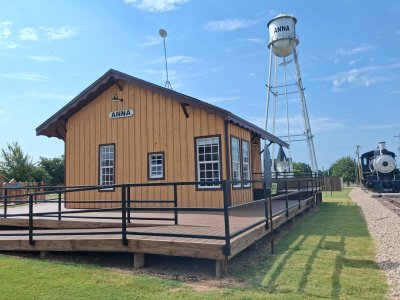 Last Saturday (August 8), I drove up to Anna, Texas, to see the oldest surviving train depot in Texas, hoping it might help me learn a little more about one or both of Richardson's now long-gone depots.
Those of you who own a copy of my two-volume history of Richardson will know that our city owes its existence to the Houston & Texas Central Railway, which built the first depot in the spring of 1873 and the second, to replace the first, in 1907.
The depot in Anna, seen here with the city's original water towers (resembling Richardson's first water tower) and a 1906 vintage steam locomotive, is the oldest extant train depot in the entire state of Texas, albeit much smaller that it was originally. According to a Texas Historical Commission marker next to the building, and also the three helpful docents I encountered inside, it was constructed in 1885, but shortened in 1937 when train depots began to be taxed according to their length.
All three of the men I encountered inside the depot, docents Bart and Allen, and director Elden Baker, were friendly, helpful, and informative. Before I left, after asking lots of questions and getting lots of helpful answers, Mr. Baker asked me for my email address, saying that some railroad historians in Frisco and/or Temple, Texas might be able to help me in my quest to find a photo, blueprint, or picture of Richardson's first depot.
Later that very same day, by email, I heard from Dennis Hogan of Frisco. He and I exchanged a few emails in which I really didn't learn much of anything I didn't already know and after I told him that, I thought that was pretty much the end of our dialogue and that I probably wouldn't hear from him again. Turns out I was wrong.
Yesterday (August 13, 2026), Mr. Hogan sent me five maps of historic downtown Richardson, dating from the 1870s to the early 1900s, which he had obtained from the Fred M. and Dale M. Springer Archives and Library at the Temple [Texas] Public Library. The first two weren't anything I hadn't seen before: Surveyor Theodore Kosse's 1878 diagram and a portion of it. But the next three maps were gold!
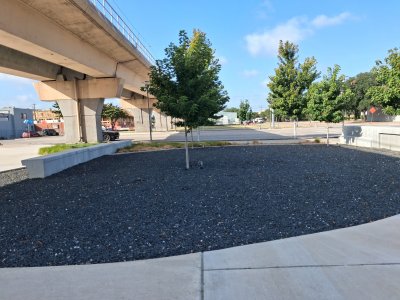 Although these maps did not contain a 3-dimensional representation of Richardson's very first train depot, they did provide some unexpected and welcome news about it. First of all, in Kosse's two plats of Richardson, dated 1873 and 1878, he showed the railroad depot as lying south of Smith Street (now Main/Belt Line), between Smith and Polk Streets, on the west side of the tracks in the present-day area between Interurban Street and the DART tracks. But the three later maps all showed the depot north of Smith/Main/Belt Line! In other words, directly across the street from where I had always thought the depot was situated!
The location of the 1873 depot, now called "Interurban Common," is shown in the photograph, left.
Moreover, these three diagrams or maps showed the exact dimensions, in feet, of the 1873 depot, with a rectangular platform all the same length and width, not smaller at one end as Kosse had drawn it.
Something else caught my eye: The lonely grave of H.&T.C. Roadmaster Patrick Burke, who reportedly died of smallpox in 1896 or earlier, and was buried beside the tracks, just a few yards north of the depot.Presumably, he is still buried there and I plan to find a way to mark the site, in some appropriate way so that it doesn't get "lost" again. The photo to the left shows that there is a recently-planted tree at the spot where I believe he is buried, or certainly close to it.
Another thing I like about these maps is that they show (and in many cases, confirm) the location of various early businesses of Richardson, as well as some private dwellings. One that is particularly near and dear to my heart is Farrell's Livery Stable, shown recisely where I thought it was, on the northwest corner of Smith Street (now Main/Belt Line) and present-day Interurban Street. Why is that near and dear to me? Because my grandfather, Charlie Miles, ran the livery stable for the Farrell family before he left the stable to became a road building supervisor for Dallas County.
You can now examine these maps to your heart's delight, on this website, in the Vintage Maps section.
So Much More Could Be Done (and I hope that it will be)
(posted Monday, June 23, 2025)
"Probably the most important step taken in the history of Richardson was Monday, when by a vote of 112 to 10, the citizens of Richardson voted to incorporate our little town."
--The Richardson Echo, June 26, 1925
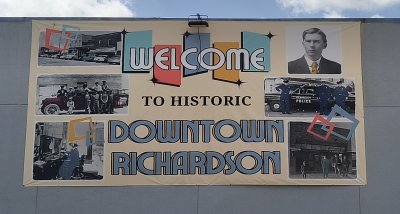 Yesterday, Sunday, June 22, 2025, was the 100th anniversary of a milestone event in our city's history: the election in which the City of Richardson, as an incorporated governmental body, was brought into existence by the votes of 112 citizens, who also elected our first mayor--35-year-old Thomas Franklin McKamy--and true to his word, our current newly-elected Mayor, Amir Omar, made good on his promise to me that the fact of that matter would receive some sort of public recognition.
Unfortunately, Mayor Omar had very little time--a month at best--to work on keeping his promise. Consequently, although there was a big banner hanging from the building (at 100 E. Main Street) where the election of 1925 took place, welcoming people to "Historic Downtown Richardson," and also a tent where the owners and staff of Beyond the Bar (Richardson's new non-alcoholic drinks establishment) served refreshing, cool drinks, and even though about 3 dozen Richardson residents showed up to join me for a guided tour of the 100 block of East Main Street, the event fell short of what I thought could have been done, and should have been done, to celebrate such a milestone anniversary.
Don't get me wrong: I am not blaming Mayor Omar. Far from it. I have nothing but good things to say about him. He lived up to his promise. As I said, he has been in office barely a month. As I see it, the failure to do more rests squarely on the shoulders of the previous administration, which under the leadership of Mayor Dubey apparently wasn't going to do anything at all until I reminded the City, back in early February of this year, of the approach of this historic anniversary. To their credit, my suggestion that a plaque commemorating the 1925 election be cast was approved. In fact, it is going to be unveiled today, at 4 p.m. at Fountain Park, in downtown Richardson. But until I, a private citizen, spoke up, it appears that nothing at all was being planned.
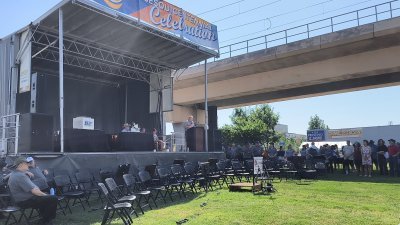 Remember the Sesquicentennial Celebration of two years ago? For this latest milestone anniversary, that's the sort of thing that should have been done this year, and more. There could have been a parade. There could have been a carnival. The City of Richardson could have used the occasion to showcase and call the public's attention to all the good things our local government has done to make Richardson a nice place to live and work and play--and to its credit, there are great many things to point to. But it didn't.
The Dubey administration can't even be credited with the Sesquicentennial celebration. Bob Dubey may have officiated at the event, which took place almost exactly two years ago, but he was then a brand-new mayor himself. Credit for the Sesquicentennial events must rightly go to the administration of Dubey's predecessor, Paul Voelker. And even then, there could have been more. I suspect, although I have no proof of it, is that the reason there wasn't more was because even the Voelker administration was unaware of the coming 150th anniversary of the founding of Richardson, until my Sesquicentennial History was published and I presented complimentary copies of Volume One to the Mayor and City Council in April 2022. As a result, they had more than a year to prepare.
I am happy to report that Mayor Omar has given me reason to hope that things are going to change, that under his leadership, the City of Richardson is going to be more cognizant of our community's shared history and also take concrete steps to make sure that our citizenry is not only aware of it, but will benefit from that cognizance in both tangible and intangible ways.
In keeping with that hope, here is a list of specific things that the City of Richardson could do in that regard, a sort of "wish list" of things that I know are doable, because many other Texas towns and cities have already done them. To be clear, no one has promised me that any of these things will be done. I'm just putting them out there, for consideration:
Officially designate old downtown Richardson as "Historic Downtown Richardson" and put up signage to that effect.
Erect signage or attach plaques to historic buildings to inform the public as to their significance in the city's history.
Paint a mural on the west side of the building at 100 E. Main, welcoming people to "Historic Downtown Richardson," with appropriate historic pictures, such as an old steam locomotive, an Interurban car, cotton wagons, interior and exterior scenes of bygone businesses, etc.
Pass an ordinance making it unlawful to demolish or significantly alter the appearance of any building or structure in Richardson that is 75 years old or older without a public hearing and permission of the city council.
Purchase the old 1898 Odd Fellows Building at 111 E. Main street, restore it to its orginal appearance, and use the bottom floor as a visitor's center and free meeting space for civic organizations, and the top floor (which was a city hall during the early 1930s) for a museum of Richardson history.
Encourage the establisment of the sort of businesses that would attract more visitors to the historic downtown area, such as restaurants, galleries, antique shops, live theater or comedy clubs, and specialty shops of various kinds.
Hold a regular street market in Walton's Alley once a month where vendors of various kinds could sell their wares or food products.
Hold an annual festival celebrating Richardson's history in Historic Downtown Richardson, with music, dancing, carnival rides, fireworks, etc. In short, revive the community fairs that used to be held in Richardson in the past.
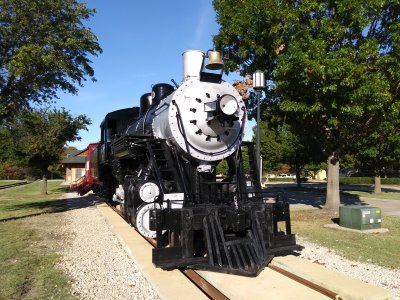
Build a replica railroad depot on the site of the 1873 depot and use it as free meeting space for civic organizations, etc., such as the City of Allen has done. Perhaps also purchase and restore an old steam locomotive as Allen has done. (See photo below.)
Change the name of Fountain Park to Heritage Park and erect a bust or statue of Alfred Stephen Richardson, the city's namesake, there.
 There are probably lots of other things that could be done to preserve and protect the few remaining historic buildings we have in old downtown Richardson, to make people more aware of our shared history, while at the same time enlivening the place so that it will regularly attract both residents and visitors from other places. All it will take, I think, is a little imagination, some money, and most importantly, the will to get it done!
But will Richardson do the sorts of things that Plano, Allen, McKinney, Denison, Paris, and lots of other Texas towns and cities have already done to turn their historic downtown areas into places that people will want to go and spend money and have a good time, while at the same time preserving the best of the past?
Check back here from time-to-time, and I'll let you know! And hopefully, our city government will also let you know.
This website copyright © 2021-2025 (except where noted) by Steven Butler, Ph.D. All rights reserved.
